
A Day of Easy Driving and Castles.
A Day of Easy Driving and Castles
We are lucky in Carmarthenshire to be close to some most fantastic Castles.
If you are looking for a day trip with no more than 30 mins driving at any one time we have the following recommendations.
Castle 1 – Carreg Cennen.
25-30 mins drive from Tŷ Mawr. (The easiest route is not following Sat Nav on the tiny roads through the Valley. Coming from Tŷ Mawr, turn right and follow the road back to the A40 and then put Sat Nav on when you reach the turning for Llandeilo on the A40 which is a T Junction.
Address: Trapp, Llandeilo SA19 6UA

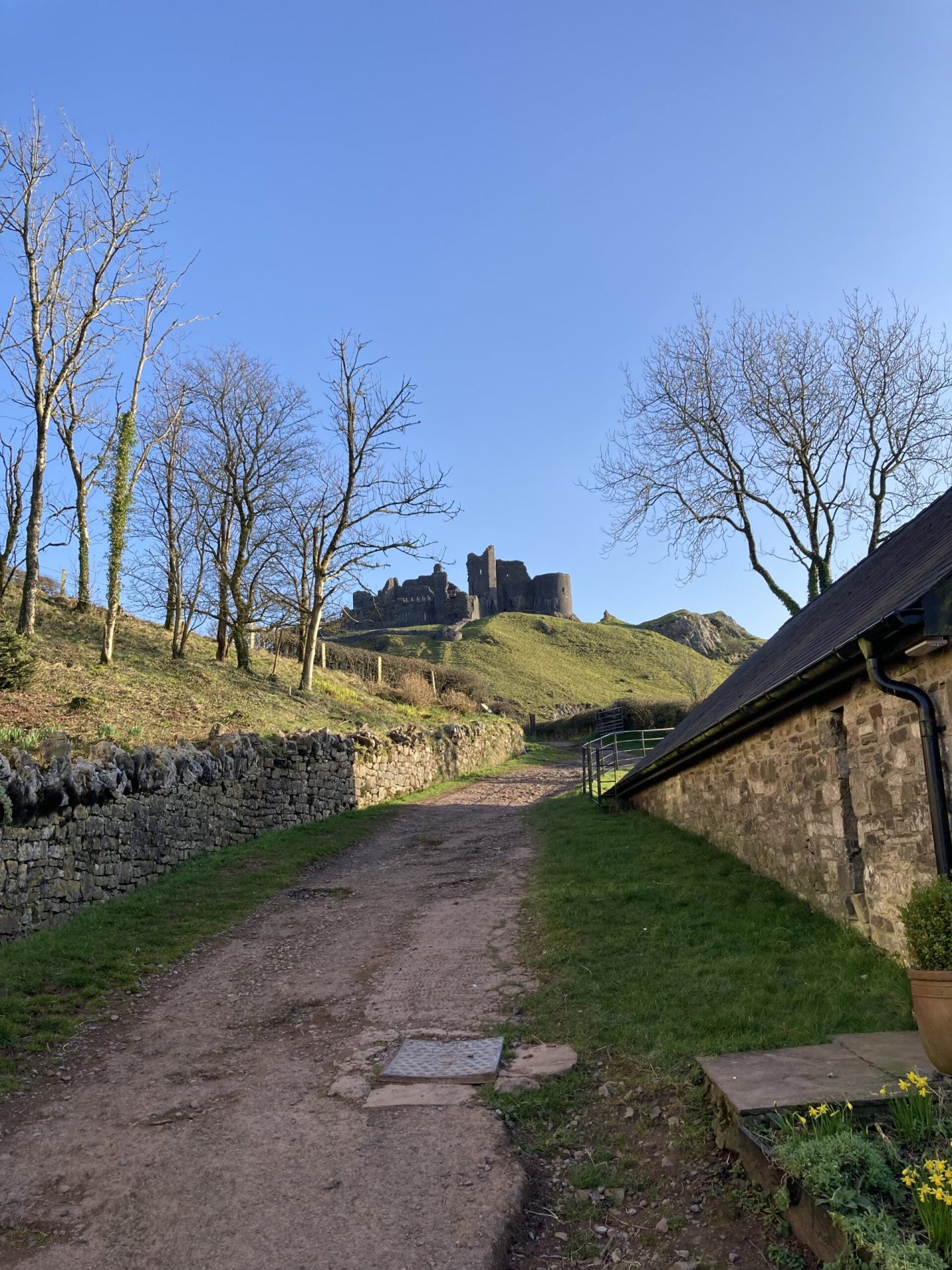
Welcome to officially the most romantic ruin in Wales – as voted by readers of Countryfile magazine. Perched on a great limestone crag nearly 300ft/90m above the River Cennen, the dramatic silhouette of Carreg Cennen dominates the skyline for miles around and commands stunning views over the Carmarthenshire countryside.
From the moment you first glimpse the castle, probably built by Edward I’s loyal baron John Giffard at the end of the 13th century, you feel an incredible sense of drama and remoteness.
The first stronghold on Carreg Cennen’s limestone crag might well have been an Iron Age hillfort. The earliest castle was probably the work of a Welsh prince – the Lord Rhys, ruler of south Wales. But the imposing ruins we see today bear all the hallmarks of a later Marcher Lord demonstrating his power, wealth and influence. This was most likely John Giffard, who fought for Edward I in the battle of Irfon Bridge in 1282.
The defeat of the Welsh army and death of Prince Llewelyn ap Gruffudd, the last native Prince of Wales, dealt a decisive blow to Welsh independence. Carreg Cennen was Giffard’s reward from a grateful English king. It probably wasn’t his main home. The formidable castle Giffard built on top of an earlier Welsh stronghold was really a symbol of control.
Carreg Cennen was part of a wave of such fortresses built by Marcher Lords throughout Wales after the Edwardian conquest. Its ‘castle within a castle’ layout and twin-towered gatehouse make it a classic example – and one that was never softened by later ‘gentrification’.
Carreg Cennen was garrisoned for the last time by Lancastrian forces during the Wars of the Roses. After its capture by Sir Roger Vaughan in 1462 a force of 500 men took four laborious months to dismantle the castle with picks and crowbars.
The castle has a wonderful café overlooking the valley.
£5.50 Entrance fee (Unless a member of Cadw.)
Castle 2 – Dinefwr Castle
Address: Llandeilo SA19 6RT
Perched in a commanding hilltop position above the Tywi Valley, Dinefwr Castle occupies a similarly significant position in Welsh history. In the 12th century, the fortress was in the possession of The Lord Rhys, ruler of the ancient south Wales kingdom of Deheubarth. His reign saw a rare period of peace and stability that led to a flowering of Welsh culture, music and poetry.
Sadly, it was not to last. After Rhys’s death, conflicts over succession led to turbulent years as the Welsh princes fought amongst themselves and against the English. Dinefwr eventually fell into English control in 1287 and remained there for centuries, despite Owain Glyndŵr’s attempt to wrest it back during his uprising of 1403.
Dinefwr Castle not only occupies a place of great affection in the minds and traditions of the Welsh people but also majestic hilltop locations above the Tywi valley. The site is forever associated with the princes of Deheubarth, the kingdom in south-west Wales.
A lack of available excavation data means uncertainty remains as to the shape, form and history of any earlier fortifications, which may underlie the medieval castles. Despite this, present evidence suggests very strongly that the history of Dinefwr Castle is entwined with the rule of the Lord Rhys (d. 1197).
Over time the castle changed hands between the princes of Deheubarth and gradually evolved into formidable fortresses. It eventually fell to the English Crown from 1287, serving as centres of royal administration and authority.
By the end of the Middle Ages the castle had become ivy-clad ruins. However, Dinefwr received a new lease of life when a conical roof constructed atop the keep created a picturesque summerhouse. It became an eighteenth-century picnicker’s paradise!
On Saturdays and Sundays the café on the outdoor terrace and the cosy fire-lit café in the house are open from 10.30am – 3.30pm. Dogs on leads welcome, too! Normal admission charges to the house apply. National Trust Run. £5 to park.
Castle 3 – Dryslwyn Castle

Address: B4297, Carmarthen SA32 8JQ
Dryslwyn Castle occupies a strong naturally defensible position on the summit of a rocky outcrop overlooking the Towy (Tywi) valley. The site was possibly the location of an Iron Age (or earlier) settlement, but the first known fortification was the castle which was established around 1220 possibly by Rhys Gryg. He was one of the sons of Rhys ap Grufford, Lord Rhys who was ruler of Deheubarth and had been sufficiently powerful to resist Anglo-Norman incursion into South Wales. However, following the death of Lord Rhys in 1197, bitter fighting broke out between rival claimants with the dispute continuing until 1216 when Llywelyn ab Iorwerth (the Great) forced a settlement on the family. The package of lands granted to Rhys Gryg included the site of Dryslwyn Castle.
Rhys Gryg married into the powerful Anglo-Norman de Clare family in 1219 and this enhancement to his status seems to have prompted the building of Dryslwyn Castle as well as upgrades to his main caput at Dinefwr Castle. Both castles were similar in plan. At Dryslwyn, the Inner Ward was dominated by a circular Keep which was originally covered in mortar and whitewashed doubtless giving it a striking appearance. What is now known as the Middle Ward, was originally protected solely by earthworks and a timber palisade. Empowered by his new fortifications, Rhys initially opposed Llywelyn ab Iorwerth’s decision to pay homage to Henry III which prompted the Welsh Prince to bring an army south to compel him to surrender. Rhys duly fell into line.
Following the death of Rhys Gryg in 1233, his lands were divided between his sons. Dryslwyn Castle passed to his younger son, Maredudd ap Rhys, whilst Dinefwr passed to the elder son, Rhys Mechyll. However, by the 1250s the two factions were squabbling over the extent of their respective territories. The disagreement was made worse by the intervention of Llywelyn ap Grufford who sided with Maredudd ap Rhys. Seeking to exploit the situation, an Anglo-Norman army sought to intervene but was defeated at Cymerau. Eventually both sides were reconciled. During his tenure, Maredudd rebuilt the castle’s Middle Ward in stone.
The Anglo-Welsh relationship changed significantly upon the death of Henry III in 1272. His successor, Edward I, lost patience with LLywelyn ap Grufford and commenced the First War of Welsh Independence in 1276. By Summer the following year Welsh opposition in the South and East had crumbled with Rhys ap Maredudd (son of Maredudd) seeking terms with the English King. He was duly allowed to keep his lands and in the subsequent years made further modifications to the castle including adding the Outer Ward complete with a projecting Square Tower. However, Rhys greatly resented the fact that his early submission to the English had not led to better rewards. The situation was made worse when relations between Rhys and Robert Tiptoft, Justiciar of South Wales, deteriorated in the 1280s. In June 1287 Rhys rebelled and captured Carreg Cennen, Dinefwr and Llandovery castles.
The English responded by deploying significant force from Carmarthen, Chester and Montgomery. By 15 August 1287 these three armies had converged on Rhys at Dryslwyn and besieged the castle. The English forces had over 11,000 men under Edmund, Earl of Cornwall. After a fierce siege, which utilised both trebuchet throwing machines and undermining, the castle surrendered on 5 September 1287. Rhys escaped but was disinherited and in 1292 was captured. He was taken to York where he was put on trial for treason, convicted and executed in April 1292.
For the rest of the thirteenth century Dryslwyn remained under Crown control with periodic repairs being made along with a number of upgrades. It was attacked during a Welsh uprising in 1316 but avoided any significant damage. The following year Edward II granted the castle to his unpopular favourite, Hugh Despenser the younger. This prompted a further attack in 1321 from the Marcher Lords who resented the extending influence of the Despensers. The castle was returned to Royal ownership in 1326 following the overthrow of Edward II and the Despenser family. By the mid-fourteenth century the castle had been neglected and was in a poor state of repair.
During the Owain Glyndŵr uprising, Dryslwyn Castle was surrendered by its Governor, Rhys ap Gruffudd, to the rebels on 4 July 1403. Glyndŵr held court at the castle where he outraged the English by rejecting a plea from John Skidmore, constable of Carreg Cennen Castle, for safe conduct for English women within the Royal castles besieged by the rebels. By 1409 the forces of Henry IV had re-asserted their authority in the Towy valley and Dryslwyn Castle was taken back into Crown control. However, a decision seems to have been made to abandon the fortification at this time with the walls being partially demolished. It was never restored.
This castle is free to visit and to park.